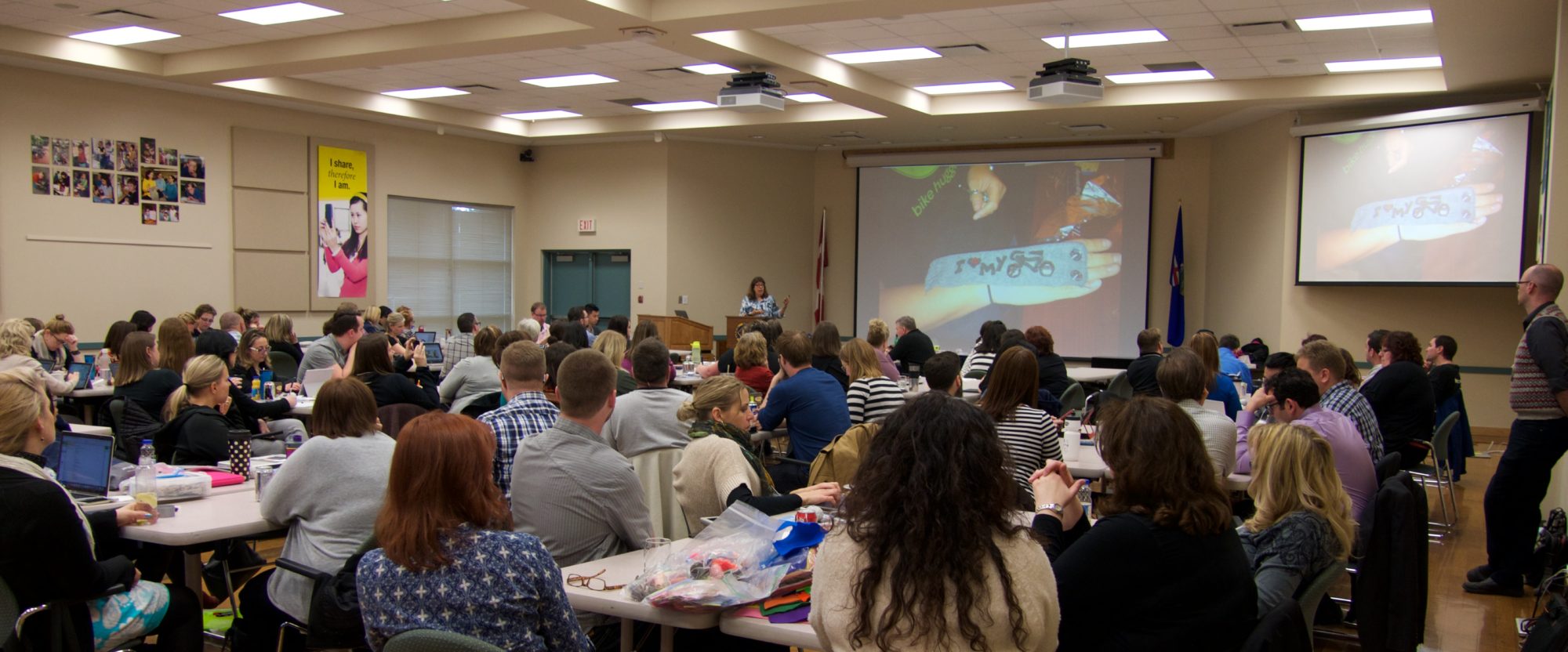
Perhaps the best commentary ever on how slideshow presentations all start to sound alike after a while:
Mini-Grants for Service-Oriented Projects for Youths
Pay It Forward Mini-Grants go to one-time-only, service-oriented activities that young people would like to perform to benefit their school, neighborhood, or greater community. Projects must contain a “pay it forward” focus, which is based on the concept of having one person do a favor for others, who in turn do favors for others, and so on, so the results grow exponentially. Maximum Award: $500. Eligibility: K-12 youths. Deadline: applications accepted starting September 15, 2008. More information.
Note: The website doesn’t say “U.S. only” but the website implies it.
Twitter as a metaphor for learning
OK, my turn. Obsession over Twitter, a microblogging tool that’s a favorite of millions thousands hundreds of edu-tech-bloggers, is running rampant over at Will Richardson’s blog Weblogg-ed – What I Hate About Twitter.
Will is ambivalent about his own reaction to Twitter, and the 103 (and counting) comments range from agreeing, explaining, dismissing, and accepting various theories about what Twitter is and should be.
In my experience, Twitter is a nice place to hang out with people. Sort of like Second Life without bumping into things. A lot like a lunch room. Twitter is simple to use and gives you 140 characters to say something, anything. You see everything your “friends” say, and you can choose your friends based on any criteria you like. So loose groups of people tend to form who have similar interests.
On Twitter, the flow of tidbits is fast and completely random. Depending on when you show up, you hear about mundane details of people’s lives, work highlights, baseball color commentary, requests for help, and more than a few musings on educational technology. Not surprisingly, when you get a bunch of people who live, work and sometimes breathe education and technology, the conversation trends that way.
On Will’s blog, the conversation about Twitter is fascinating. People love Twitter, hate Twitter, can’t stand the cacophony, want it to be neater and more organized, accept Twitter for what it is, and much much more.
But my thoughts are going elsewhere today. I’m thinking about Twitter as a human laboratory — as a metaphor for learning. Twitter is what it is. How people react to it is a mirror of how they manage their own experience and their own needs.
Imagine if we let children manage their own learning like this?
How many kids get the chance to express their needs in their learning process. Clay Burrell says, “I tend to jump in, swim around like a fish in a wine barrel, then flop out to dry up for a few days or weeks. Then jump back in again. I love the playfulness, the sharing, the relationships.”
Is there every a time we let students “swim around” in learning and then have a chance to reflect, to think, to catch their mental breath?
Nate Stearns says, “Twitter doesn’t work for me, but I know that’s more about me than anything else. I like longer bits to digest” Do we ever give children this choice?
Jarred says, “I often feel a need to “keep up” with the high-frequency tweeters out there…“ How many students are paralyzed by the competitive nature of many classroom activities?
From Christian Long, “The more we seek to create Twitterquette, the more the organic joy of it all becomes watered down so that only a small group of like-minded souls are willing to hang out.” From kindergarten on, school becomes increasingly structured and less joyful. In the end, only certain kinds of students thrive in this environment. We label these like-minded souls “successful” and denigrate the wandering souls with punishment, ever-more boring and structured courses with even less chance to find what might spark a love of learning.
You could read every single comment and create parallels about how most school experiences are so different than what we expect for our own learning.
Hopefully, you’ve realized by this time that I’m NOT advocating Twitter for the classroom, or even Twitter as a necessary part of an educator’s professional development. Far from it. Nor am I advocating that learning should all be freeform and lacking a guiding hand.
Some students can take the always-on, highly organized and structured nature of the classroom – but many can’t. What can we learn from Twitter to allow a more natural, unstructured mix of learning and socializing that might actually feel soothing to some students?
The “feeling” of Twitter may actually be what many educators hope to encourage in an inquiry-driven, project-based classroom. The thrill of getting an unexpected answer to your exact question. The ability to choose when to jump in and when to hang back.The excitement of an intellectual gauntlet thrown down and picked up. Watching experts do battle and learning that there are words to express your own inner thoughts in a more intellectual, accomplished way. Watching people verbally implode and thinking, “I won’t do that!” Socializing in a group and celebrating the common goofy humanness of all different kinds of people.
Educators who create climates of possibility in a classroom sometimes make it look easy, but it’s far more tricky than it looks to guide groups of students in goal-oriented, academic tasks while still allowing them to drive their own learning. I talk to teachers all the time who have been tweaking project assignments for years, subtly changing minor details of timing, instruction, environment and tools to increase the level of student agency while also increasing the quality of student work. It’s difficult, painstaking, rewarding work.
What might Twitter teach us about creating these learning environments?
- The rewards of serendipity
- Making it simple to participate, contribute, or watch
- The importance of socializing
- Choice
- Freeing up time constraints
- Questioning whether imposed rules increase or limit participation
Your thoughts?
Sylvia
Back to basics?
Flying home from San Antonio, Texas and the National Education Computing Conference (NECC), my head was full of ideas about pushing the boundaries of teaching and learning. Sitting next to me was an older gentleman from Texas. He was a grandfather nearing retirement, working in the banking industry. We exchanged the usual family and job facts, and as usual whenever I mention that I work with schools, he wanted to share some stories. Of course, everyone is an expert at school. They went, they have children — it’s the one institution that we all have in common. People like telling their stories.
This particular Texas gentleman had grandchildren ranging in age from babies to teens, and his daughter was a teacher too. “It’s not like back when I went to school,” he said after a time, and I braced for the rest of the sentence. I fully expected it to be something about getting back to basics, or how today’s kids don’t value education and the parents don’t discipline them.
But then he said something completely different. He said that when he went to school, his teachers encouraged him to think, and that they helped students do their work, not just memorize facts. He said that he’s often in his grandchildren’s classrooms and “the teachers talk all the time” from the front of the class and wondered how anyone could learn like that. “It wasn’t like that when I was young,” he sighed.
Later on, I sat there questioning all my assumptions. Of course not all “olden days” teachers were drilling students. How could I have had that image in my head? When people think about the past, of course we all have had different experiences. Talking about how school used to be is meaningless; it’s too dependent on your personal experience. Unfortunately, we hear this kind of language all the time, whether it’s to point at the “bad old days” or the “good old days” Neither of them exist in reality.
People are always searching for the new new thing – it’s human nature to enjoy stimulating new ideas. However, things like 21st century skills, where we try to define what students need to know “now” (as if creative thinking wasn’t ever valued,) is a solution to a problem that may not exist. It may just be a reflection of our vast, yet fundamentally faulty collective memory of things that never were.
Sylvia
Twitter buys Summize – should educators care?
Yesterday’s news brought a new Web 2.0 related announcement. Micro-blogging favorite Twitter has purchased Summize, a Twitter search engine.
Twitter has become the new tool of the day for many edu-bloggers (like me). It’s great for keeping up with personal networks, keeping track of people at conferences, and just chatting. There have been a few educators interested in the educational potential, but mostly, it’s been a tool for sharing and socializing. Twitter is also a favorite of many marketing social networking gurus, some who have amassed tens of thousands of followers. Like the early days of Google when it broke out of the pack of dozens of popular search engines, Twitter seems to be at the tipping point of widespread use.
Many other Web 2.0 applications have sprung up in the fertile Twitter ground, dedicated to providing a better user interface, connections to other tools, or better search and conversation tracking. Summize was one of them.
Yesterday, Twitter bought Summize, and now the Summize search can be found at the subdomain search.twitter.com. The speculation is that the purchase was made in Twitter stock, plus jobs for the five Summize employees at Twitter. All this for two companies that make zero revenue!
But somebody believes that Twitter is worth something – they’ve been funded with 15 million dollars of venture capital. That’s not a gift, somebody is expecting them to return that 15 million with much more on top. Other venture capitalists have invested 1 million dollars in Summize.
So Twitter believes that Summize is worth money. And the VCs that own a piece of Summize most likely believe that their million dollar investment is now going to pay off big time.
So what’s the education angle here?
For educators, Web 2.0 apps offer some amazing features for collaborating, communicating, access to data, photos, audio, video, and more. But the main reason it appeals is the price – free. For many schools scrambling to balance the budget, free overrides all other features. Educators find out about these apps the same way everyone else does – buzz and early adopters. The more people flock to these sites, the greater the chance they might break out of the pack and become the darling of the moment. And that’s how they attract venture capital, which allows them to stay in business, expand, and gain more customers. Buzz is the business of these Web 2.0 companies, even more important than the products they make. If the buzz is big enough, they might hit the Google jackpot and make millions.
So you have to ask yourself, is “buzz” plus “free” driving educational practice and planning? Are you building a future on this premise? Are educators walking into a trap set out to attract any and all users, just so venture capitalists can make a return on investment?
Sure, you could argue that we’ll just use these tools as long as they’re around, and then move on to whatever the new new thing is. But by then, how much of your current technology plans will have shifted to relying on things being free? If you have sold Web 2.0 to your colleagues, principal, and superintendent as the way of the future, what happens when these companies finish their speculative games, take their money and go home?
So while you might not care about Twitter, this particular bit of Web 2.0 business news is just the tip of the iceberg for the coming consolidation.
We all know that day is coming, when the companies that don’t get enough buzz to attract money will shut down their free services. Once the money in Web 2.0 settles out everything will change. The VCs will find a hot thing to invest in. A few lucky little companies will get bought or turn into big companies, and that monetize word will have real meaning. The rest will go away.
It’s not a matter of if, but when. Are you ready?
Sylvia
All day buffet for the soul
“It’s a simple idea: Inspire Action. Change the world. Have Fun. Because doing good shouldn’t feel like a chore.”
Alldaybuffet.org is a site created to connect people with causes that matter.
Enjoy.
Sylvia
Anticipating an Educational Revolution
 I got a message today from Carolyn Foote, aka technolibrary on Twitter, with a link to this article in the New York Times – High Cost of Driving Ignites Online Classes Boom.
I’d almost forgotten that we’d gotten off on an interesting tangent at one of the NECC 2008 EdubloggerCon conversations. It was Will Richardson’s discussion group on Here Comes Everybody, the current bestselling book by Clay Shirky. Will has done a couple of terrific blog posts about this book (here’s one), and recently did an interview with the author.
We were talking about revolutions, and whether education is ready for one, and why is it taking so darn long when it’s so obvious that we need one. My comment was that most revolutions don’t happen for the right reasons, they often happen for disconnected reasons that somehow push a mass of people past a tipping point, or when something happens that shocks people out of behaviors that seem set in stone.
And in fact, my example was that gas prices may well be the catalyst for the educational revolution we’ve all been waiting for; that arguing for a revolution may well be a waste of time, but that being prepared may make all the difference.
Chris Lehmann’s recent blog post, Why Educational Change is Hard (and the limits of “Here Comes Everybody” for schools, brings this up in a different way. He writes, “We have to understand, in ways that Shirky describes, why low-risk mediocrity is almost predictably a better outcome than high-risk success.”
Revolutions stall at the gate because of this. Revolutions are high-risk endeavors. “The devil you know…” (which is such a good cliche that you don’t even have to finish the sentence.) Revolutions aren’t planned by committees of well-meaning citizens. Something unpredictable happens, and then history is written by the prepared and the lucky.
Will gas prices be the tipping point for an educational revolution? Perhaps. Will it be the revolution we want? Maybe. I certainly think it has the potential to deliver the kind of systemic, no-boundaries impact that could shake the basic structure of school as we know it.
Once you mess with the bus schedule, can the bell schedule be far behind?
Dear Administrator…
 Scott McLeod of the Dangerously Irrelevant blog has invited all bloggers to contribute to an annual tradition of his.
On July 4, 2008, blog about whatever you like related to effective school technology leadership: successes, challenges, reflections, needs. Write a letter to the administrators in your area. Post a top ten list. Make a podcast or a video. Highlight a local success or challenge. Recommend some readings. Do an interview of a successful technology leader. Respond to some of the questions below or make up your own.
Dear Administrator:
Just do it.
OK, that’s it.
Well really, there’s more, but that’s the gist of it. Technology is a fact of life. Allow it to be part of your students’ lives in ways they can control. Give your teachers time to explore new ideas about pedagogy as they introduce technology. Encourage your teachers to use it in ways that shift agency to the student. Fight the tyranny of the new but don’t get stuck in old ways either. Yes, we all know it’s a crazy, impossible balancing act. That’s the job.
Wake up, smell the coffee, the world is not going to wait for another committee meeting or district re-organization or the next version of Windows before it moves on. Don’t worry about China or economic globalization flat-world whatever, the reason to lead your school into the future is because there is no alternative.
Are you worried about parents? Give your students time and resources to produce creative technology projects that will be so compelling that it’s obvious you are doing the right thing. Your PR to the community is crucial. Calm the crazy ones down but don’t let them paralyze you. Ask parents who “get it” to be allies. I can’t tell you the number of times as a parent I found out too late that my kid’s principal changed good policies because of one unreasonable parent and never told anyone.
Are you worried that kids will be kids and something “bad” might happen? When has something bad not happened along with the good. Mistakes are learning experiences. Do the obvious – backups, necessary security but not more, and then if something happens, fix it. It’s up to you to lead with positive energy, not fear.
Are you wondering about “kids these days”? Don’t – they aren’t that different than we were. They want to be heard, loved, respected, taught, and challenged. Technology is just a part of their world, not a secret handshake.
Students are 92% of the population at your school site – to be a leader, you have to lead 100% of the population, not just the 8% who look like you. A leader understands who he/she is leading, but you don’t have to BE the same as them.
So if it feels better to figure out Facebook or ipods or your cell phone, that’s great. But that’s just part of the equation. It always astonishes me when educators go to conferences to hear student panels, and then rave about how much they learned. Why is this a surprise? YOUR KIDS ARE THE SAME, why aren’t you talking to them? They aren’t geniuses, they don’t have all the answers, but they ARE the answer. It’s up to you to unlock that puzzle.
And for goodness sakes, DO something.
Student technology assessment panel – NECC
Yesterday at the National Educational Computing Conference (NECC 2008) I was on a panel about technology literacy assessment. Agnes Zaorski of Eatontown Public Schools led the discussion, with Cathy Higgins, the state director of educational technology in New Hampshire, Ashanti Jefferson from Chicago Public Schools and me. We were there to talk about different approaches to meeting the NCLB mandate that every student be technology literacy by grade 8.
Ashanti spoke about how they have created an open-ended set of tools, resources and training, so that teachers could choose to keep technology integrated into the classroom. Cathy talked about portfolio assessment, and how they have thoughtfully planned the system with input from the entire state, and how that fit into their philosophy of students using technology to do their work, share, and save them digitally.
I’m not doing justice to these projects in one sentence, but for me, the key was the deliberation and thoughtfulness that they and many others have put into the solutions and resources.
The audience was made up of people from across the US, and possibly around the world. They too asked thoughtful questions and described situations in their own classrooms and offices where they were trying to do the right thing. But to me, a theme started to emerge.
Distrust. Not distrust of what is being said, or what is being set as policy, but that it will last. That it won’t be changed tomorrow and all the plans and implementations, successful or not, will be tossed in the trash can.
So when the federal government says in NCLB that all students must be technology literate by the 8th grade, that’s a pretty broad statement. So the states say, what does that mean? And the federal government has responded, “we aren’t going to set guidelines, we’ll leave that up to the states.” You could interpret that two ways:
- Hurray! We get to design tech literacy ourselves, and assess it authentically. Now let’s get to work on what that means!
- Uh oh, it’s a trick to make us do a lot of work and then when we come up with a solution the darn Feds will tell us what they really meant and we’ll have to do it their way anyway.
Now imagine this chain of uncertainty and mistrust of an open policy all down the line.
States don’t trust feds, districts don’t trust states, schools don’t trust district when they say things are open for definition. Because if you’ve been around for a while, you know that sooner or later someone comes along and says, “SIKE! The answer is 42”
So it’s easier to ask that the rules be set in stone, so you know you won’t go to a lot of effort creating a child-centered, thoughtful policy only to have to throw it out next year when the new principal/superintendent/state education department coordinator changes their mind.
Open policies with multiple paths to completion are what we hope for and fear. They come with a gift of choice PLUS the potential for even more work when you find out that when the powers-that-be said “choice” they meant, “choose my way”
We live in interesting times…
Sylvia
Solutions to the Dropout Crisis – Webcast Series
The Solutions to the Dropout Crisis series is available on the 4th Tuesday of every month at 3:30 PM Eastern Time. This is a live call-in show featuring international experts and authors in drop-out prevention. Click here to access the website, archives, and many supplementary resources.
This program is a public service of Clemson University. There is no fee, and no registration is required. You may listen to the program and view the supplementary materials using only your computer, either live or afterwards. You will need to call in if you wish to speak on the live program.