A crisis (or opportunity) for service-learning in schools

A recently released report “Community Service and Service-Learning in America’s Schools” by the Corporation for National & Community Service, analyzes trends in service-learning for youth.

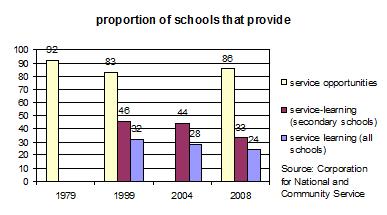
The numbers are interesting – the percentage of K-12 schools who say they “recognize” or “arrange” student participation in community service remains high. Although down slightly from a whopping 92% in 1979, it increased from 83% to 86% in the nine years since the last survey. But the study confirms a downward trend in school service-learning, from 32 percent in 1999 to 24 percent in 2008.
Community service is different from service-learning. Service-learning has clear curriculum and learning objectives, and is integrated into classes and subjects. So for a school, service-learning is a bigger commitment that requires funding, resources, and attention, all of which are in short supply these days.

Peter Levine blogged this past week about this crisis in the service-learning movement. Peter is director of CIRCLE, (The Center for Information and Research on Civic Learning and Engagement) out of Tufts University which conducts research on the civic and political engagement of Americans between the ages of 15 and 25.

He says,

“It’s my sense that the movement for service-learning has reached a crisis point. It isn’t included in federal education law; it isn’t a priority in an era of concern about reading and math; the federal funding has been cut (in real terms) since 2001; and the quality of programs is so uneven that outsiders could be reasonably skeptical about its value.”

Dan Butin of The Education Policy Blog blames this directly on NCLB, “In such an age of standardized accountability, of course service-learning offerings would be minimized and marginalized. And especially when a reform effort at the K-12 level is not rooted deeply, it becomes a casualty of another innovative pedagogical and curricular offering left behind in an age of all too many things left behind.”

Of course, every crisis brings the opportunity for creative solutions. Peter goes on:“On the other hand, the best programs are superb; they fit the outlook of the incoming administration; and there is strong support for service-learning in the Kennedy-Hatch Serve-America bill that both Senators McCain and Obama promised to sign. That bill would direct most resources to poor districts, which today are much less likely to offer service-learning. So we could be poised for improvements in quality, quantity, and equality. Or else service-learning could falter if Kennedy-Hatch isn’t fully funded and the grassroots movement continues to shrink.”

Yes, we can!
The time could not be better to reinvigorate service-learning in schools. Schools can become centers of community redevelopment, eco-awareness, technology support, and service. With support and funding,  service-learning could transform lives of youth and bring community benefits — especially in poor neighborhoods where the need is greatest and these programs have the most impact.

Direct link to report: Community Service and Service-Learning in America’s Schools 2008 (PDF)

Sylvia

Subscribe to the Generation YES Blog

More on Fair Use and ending copyright confusion

Last week’s post, Fair use explained for educators announced a new resource, The Code of Best Practices in Fair Use for Media Literacy Education. In the comments, Kristen Hokansen, a Pennsylvania educator and tech coach added more support resources that deserved a new post all their own!

Kristen actually attended the announcement event in Philadelphia and helped create a wikispace called Copyright Confusion that will become a forum for educators. If you have time, watch the ustream and a live blog of the event that are archived here, there are some really great points brought up. Kristen also wrote about the event on her own blog The END to Copyright Confusion~and a new beginning that adds more explanation and nuance to this very confusing subject.

Kristen says, “I encourage folks to visit, and join, and share how they are dealing with this release and encouraging folks to exercise their rights as content creators under fair use. I also recommend checking out the Teaching About Fair Use page on Temple Media Lab’s site. There are all kinds of great lessons, examples, case studies and materials that can be used to help develop understanding.”

Sylvia

Subscribe to the Generation YES Blog

Contest – create a G1G1 commercial for national TV

From Daymotion (a video sharing website):

Submit your Give One Get One (G1G1) commercial for a chance to win a national TV spot! This an amazing opportunity for you to “give back“ during the holiday season and have the chance for even broader exposure of your creative work.

Video guidelines: Create a 30 or 60 second video promoting One Laptop per Child Give One Get One campaign. Get inspired by the concept of connecting children around the world. Need a prompt? How about the G1G1 tagline: Give a laptop, Get a laptop, Change the world

You can be as creative as you want! But remember, the commercial should be kid friendly. In fact, kids are encouraged to participate, along with the guidance and support of a parent or legal guardian. For prize consideration, all submissions must be 100% original, please do not use copyrighted images or music.

Contest begins November 17, 2008 and closes December 15, 2008. Only US residents are eligible for prize consideration.

More details here.

Note: Be aware that if you stray off the G1G1 page at Daymotion, there are videos available that have inappropriate themes for classroom use.

Sylvia

Back to New York and NYSCATE

Well, it seems like I just got home from the east coast, and I’m off again!

This time I’m headed for the New York State education technology conference NYSCATE in Rochester, NY November 23-25, 2008. I’m looking forward to seeing old friends and meeting new ones, most likely at Dinosaur BBQ.

If you are going to NYSCATE, be sure to check out these sessions:

NYSSTL –Technology Leadership for the 21st Century
Sunday, 1:45PM Stacy Ward
Learn how the HFM and WSWHE BOCES have created the New York State Student Technology Leaders (NYSSTL) Club in 30 middle schools. Students help their teachers learn to use technology and their classmates prove their tech literacy, creating a community of 21st century learning in our schools.

Where Teachers Learn, Where Teachers Teach
Monday, 10:45AM Sylvia Martinez
For many teachers, technology professional development happens outside the classroom and never crosses the doorstep into the classroom. This session will explore two models of professional development that cross that barrier: classroom embedded and student-led professional development.

Little Green Monsters: The XO and Its Implication For Education
Tuesday 10:30AM Brian C. Smith, Sylvia Martinez, Dr. Gary Stager
The XO low cost laptop was designed to revolutionize education in the developing world. The panel will discuss the lessons we can gain from this learning initiative and the implications for the future of education. We will also explore why such a simple idea has created such controversy.

By the way, I’m happy to have someone record, live blog, or ustream my sessions IF you can come and do it. It’s just too hard to do it AND present.

After that, it’s back to New York City for a family/friends Thanksgiving, and then some workshops in Brooklyn. More about that later!

Sylvia

Subscribe to the Generation YES Blog

Promoting the XO laptop Give One, Get One program

As I mentioned in this post early this week, the XO laptop (also known as the $100 laptop) from the One Laptop Per Child (OLPC) Foundation has started a campaign to put more laptops in the hands of children around the world. The Give One, Get One (G1G1) program allows anyone in the U.S. and EU countries to purchase two laptops, one for themselves and one for a child somewhere in the world.

Last year, with very little publicity and a shoestring distribution network, people funded over 100,000 laptops now in use around the world. That was an amazing show of support. But this year is going to be different.

Amazon.com is handling the distribution, with their reliable shipping, tracking, and return handling. There should be no repeat of last year’s long delays and lack of information.

The publicity this year is being handled by some big names too. According to the New York Times,

Television time, billboard space and magazine pages are being donated by media companies, including the News Corporation, CBS and Time Warner.

The advertising time is donated, and the spots are expected to start conversations. One spot is an uplifting vision of a 7-year-old girl in a South African township, sitting in a dark room, her face lighted only by the laptop’s glow. “With education, we will solve our own problems,” she says.

Another TV spot says children learn quickly, whatever their tools of survival are — whether loading an AK-47 or mastering an XO laptop. Other settings show child labor camps and child prostitutes. “There are some very challenging scenes,” said Paul Lavoie, chairman of Taxi, the agency that created the ads.

(For those of you with YouTube blocked, this is one of the planned commercials, Zimi’s Story.)

There’s room for us too!
Just because some big names are pitching in doesn’t mean there’s no room for us regular folks! This is still a grass roots campaign, and we can all help. Everything from blog posts and fundraisers at schools, to using the XO as a lesson for our well-off children about how education matters most to those who have the least.

Here’s a great example – Dr. Gary Stager’sLearning and TechnologyOnline Master of Arts in Educational Technology class at Pepperdine University collaborated to create a web site promoting the One Laptop Per Child Foundation’s Give One, Get One program.

This website, Laptops4Kids.net, helps people understand how the G1G1 program works by pulling together information that is scattered on various websites and wikis. For example, they created a downloadable flyer that would be useful for a school event or fundraiser.

Not only did they build this website, they sent out a press release to announce it. These educators are learning that technology in education is not just about the equipment, but about winning the hearts and minds of everyone involved to build support for initiatives they believe in.

Give One, Get One, Change the World!

Next up – what can K-12 schools and students do to support the XO laptop program?

Sylvia

Subscribe to the Generation YES Blog

The people in the room are the right people

Last week I was the closing keynote at NEIT 2008, the New York State Association of Independent Schools (NYSAIS) Education and Information Technology conference. It was an “unconference” and used a structure called “Open Space” to plan and manage the meetings. Other than the two keynote “anchors”, there were no planned sessions.

Open Space Technology is “a simple way to run productive meetings, for five to 2000+ people, and a powerful way to lead any kind of organization, in everyday practice and extraordinary change.”

At NAIS 2008, I found it very successful, and at the same time, a powerful metaphor for learning.

At the beginning of the conference, everyone is free to step up and propose any session they want. Not just ones they want to present, but anything they want to know more about. And then as these suggestions begin to fill the slots, more ideas come forward. After a few sessions, you have another meeting and fill more slots, propose more ideas. (More about how this works)

When it started, it seemed like there were way too many open spots and not enough ideas. People worried that voting would help sort out what to do, that their ideas wouldn’t be popular, that they would miss things, or that we would run out of ideas. But as we heard the Open Space Four Principles and One Law it started to make more sense:

Four Principles

  • Whoever comes is the right people
  • Whenever it starts is the right time
  • Whatever happens is the only thing that could have
  • When it’s over, it’s over

The one law is The Law of Two Feet, meaning, if you want to be somewhere else, do it – just don’t waste the time.

How it worked
Sure enough, most sessions had enough people. Part of the success was due to the facility having many small rooms, enough to accommodate all the proposed sessions. Some had projectors, some didn’t but it all worked out. When we re-gathered for the next planning sessions, people were energized, more sessions were proposed, people decided to continue or repeat a session, and slowly the open slots were filled

I’ve been to other unconferences, and this one was different. Because there was no voting, there was no competitive element and no hidden message that only the most popular ideas or people are important. While I understand that often the physical space is a limitation, I think there must be ways to acknowledge that everyone can contribute.

As I went to various sessions, people were passionate and focused. It’s the first conference in years where I went to every session and wished there were more. Lots of people said the same thing. You know when you go to a conference and the best part is the conversation in the hall? This was all hall.

The kids in the room are the right kids
But really, isn’t this what we hope for classrooms, especially project-based learning environments? Sometimes it’s hard to explain project-based learning. It’s hard to convince others that it actually works, because it’s hard to “see” the learning when the teaching is not continuous direct instruction. You have to trust the process, design situations that will engage students, and then give students time to become immersed in them. You have to trust the students and allow them to take risks, make mistakes, overcome frustrations and work through momentary distractions. You have to believe that your kids are the right kids, that you are the right teacher, and that when it all works, it will be magic.

I took a risk too, I didn’t prepare my keynote presentation until the night before. I felt I wanted to honor the process and trust that the experience of the conference would provide support for my topic of leadership vision to action, especially student leadership. And it did. I liked what I came up with, and the audience seemed to as well. It was videotaped, but apparently only the audio worked. Oh well!

I knew I wasn’t going THAT far out on a limb; I have enough videos and examples that I can pull together fairly quickly. But the theme of trusting the process and the participants ended up providing the perfect context.

Your kids are the right kids, you are the right teacher, and now is the right time. Trust them, trust yourself, trust the process. Now let’s get busy.

Give a Laptop. Get a Laptop. Change the World

Starting today the XO laptop will once again be available to consumers in the US and the EU. This is the remarkable laptop invented by the One Laptop Per Child organization for children in the developing world.

In the Give One, Get One (G1G1) program, you have the opportunity purchase two XO computers. You get one, and a child somewhere in the developing world gets the other. Last year, over 100,000 laptops were donated to children this way. (See photos)

This year will be even better!
Last year, there were problems with the distribution, as OLPC was running it by themselves on a shoestring. This year, Amazon will run it. It would be the understatement of the year to say it will be better. There are a few other changes this year as well – it will include EU countries plus a few extra (full list and FAQs here). Sorry my Aussie friends, no mention of your part of the world.

Other good news, this will be an ongoing program. So if you have an idea about doing a fundraiser or planning a school event to get your own XOs, you have time.

Posts about the XO
Last year I got an XO laptop through the Give One, Get One program. Some of my posts from last year:

Spread the word! Here are some suggestions from the OLPC G1G1 wiki page:

  • Blog it, add a comment about it to every article about OLPC and the XO.
  • Social site updates — Facebook, Twitter[1], MySpace : there are OLPC accounts on many of these sites which need maintenance and regular updating. For instance some 2007-era badges and promotions need to be updated to link to the Amazon site.
  • Viral marketing. Put http://www.amazon.com/xo in your e-mail signature. Mention G1G1 in blog posts. Comment on misinformed or incomplete articles online, and include the link and the date, Nov. 17.

Sylvia

Subscribe to the Generation YES Blog

Children are collaboration machines

I loved finding this blog post, Why Am I Surprised? from mom and tech integration coach Melanie Holtsman. Melanie shares a wonderful anecdote (and the cutest picture ever) about her five year old twins and their Nintendo DSs.

But I was surprised when I heard them giggling at the same time and it occurred to me…if they are playing two different games, then why are they laughing at the same time? I went to investigate and this is what I discovered.

They were texting each other!

First of all, I didn’t know that a Nintendo DS had this feature. Second of all, my twins are non-readers and non-writers. So how were they texting? In rebus style!


I shouldn’t be surprised. This is why I love technology. Kids do things with technology that exceed my expectations. All. the. time.

So – did you see that? These kids are “non-readers and non-writers” but they are natural collaborators and communicators. This is a perfect example of what kids do ALL the time if we set up the conditions, encourage them, and then LET THEM. They will exceed expectations, as Melanie says, “All. the. time.”

Sylvia

Subscribe to the Generation YES Blog

Quote for the day

“All I am saying in this book can be summed up in two words: Trust Children. Nothing could be more simple, or more difficult. Difficult because to trust children we must first learn to trust ourselves, and most of us were taught as children that we could not be trusted.

John Holt – American educator and author

What Makes a Good Project?

The Creative Educator magazine is running first of a two-part article on project- based learning by Gary Stager and illustrated by Peter Reynolds.

What Makes a Good Project? covers eight elements of projects that make them worth doing:

  • Purpose and relevance
  • Sufficient time
  • Complexity
  • Intensity
  • Connected to others
  • Access to materials
  • Shareable
  • Novelty

Stager concludes with questions teachers can ask themselves to improve the design of project-based learning experiences for students.

Project-based learning does take extra work to design and implement, but the results are worth it for everyone involved. So if you make the effort, it’s worth doing it right. As Stager says, “Making things is better than being passive, but making good things is even better!”

Update – Part 2 of this article is now online!  Part 2: What Makes a Good Project